I've been always fascinated by how life and beauty blooms even in the most harsh circumstances. It is in a way a certain kind of resilience, a genuine manifestation of adaptation and survival. In Mexico City, even as polluted and populated as it is, you'll always find yellow flowers blooming in between the concrete blocks on the sidewalks. In the same way, you'll always meet people that have managed to find joy in what appears to be hostile routines. "I love cinema, artistic films and reading science fiction," a taxi driver told me as he drove me from Condesa to Polanco in Mexico City, "I read during traffic lights, and take advantage of the long hours I spend stuck in traffic". Ten years ago my mother, grandmother and me made a road trip in search of our roots in Jalisco. We drove to Platanar, a small village two hours away from Guadalajara that came into oblivion when a highway was built destroying its plantations and making it impossible for drivers to drive through it; or even know of its existence. Manuel, my grandmother's cousin, still lived there and took care of his parents, who must have been almost a hundred years old. They lived in a house in ruins, most of the ceilings where long gone, and the interior patio of a once colonial house was covered with fallen walls, bricks, oxidized pieces of metal and long-stem wild grass. I was surprised to find out that Manuel appeared content with his life, and even more so to discover that he could easily talk about black holes, fractals or bio-technology. Everything he had done all his life was to read every single publication that made its way to Platanar; this included years of volumes of Selection of Reader's Digest. Nobel Prize writer Wole Soyinka spent 27 months in jail before fleeing his native Nigeria to the United States. He was denied access to books, paper and ink so he tried to remember every possible mathematic equation to keep his mind alive. These stories remind me of one of my favorite movie scenes from The Diving Bell and the Butterfly: I survived because I held to my own humanity. That's all I could do because that is all I had. Like you. Cling to your own humanity and you'll survive. Like yellow flowers blooming from concrete blocks.
Saturday, August 28, 2010
Yellow Flowers
I've been always fascinated by how life and beauty blooms even in the most harsh circumstances. It is in a way a certain kind of resilience, a genuine manifestation of adaptation and survival. In Mexico City, even as polluted and populated as it is, you'll always find yellow flowers blooming in between the concrete blocks on the sidewalks. In the same way, you'll always meet people that have managed to find joy in what appears to be hostile routines. "I love cinema, artistic films and reading science fiction," a taxi driver told me as he drove me from Condesa to Polanco in Mexico City, "I read during traffic lights, and take advantage of the long hours I spend stuck in traffic". Ten years ago my mother, grandmother and me made a road trip in search of our roots in Jalisco. We drove to Platanar, a small village two hours away from Guadalajara that came into oblivion when a highway was built destroying its plantations and making it impossible for drivers to drive through it; or even know of its existence. Manuel, my grandmother's cousin, still lived there and took care of his parents, who must have been almost a hundred years old. They lived in a house in ruins, most of the ceilings where long gone, and the interior patio of a once colonial house was covered with fallen walls, bricks, oxidized pieces of metal and long-stem wild grass. I was surprised to find out that Manuel appeared content with his life, and even more so to discover that he could easily talk about black holes, fractals or bio-technology. Everything he had done all his life was to read every single publication that made its way to Platanar; this included years of volumes of Selection of Reader's Digest. Nobel Prize writer Wole Soyinka spent 27 months in jail before fleeing his native Nigeria to the United States. He was denied access to books, paper and ink so he tried to remember every possible mathematic equation to keep his mind alive. These stories remind me of one of my favorite movie scenes from The Diving Bell and the Butterfly: I survived because I held to my own humanity. That's all I could do because that is all I had. Like you. Cling to your own humanity and you'll survive. Like yellow flowers blooming from concrete blocks.
Monday, August 16, 2010
Wednesday, August 4, 2010
I love myself in this picture as it reminds me of my inner strength. Looking straightforwardly at the camera, so secure of myself, my elbows resting on the car and with the expression of someone that has lots of ideas to share and is confident on who she is; feeling beautiful with being messy. Sunday, August 1, 2010
Notes on redemption, ambiguity and archetypes
“We all can relate to a redemption story”, Troy said at brunch a few weeks ago. His comment sank in as I was just reading a piece on the use of archetypes and ambiguity in storytelling as a way to appeal to a greater audience. Stories of redemption are indeed part of our collective memory, even when the redeemer, the need for redemption and its process are contextual. I read in a book review in the Financial Times that there are universally shared truths that are arrived at differently in many systems of thought. If our choice of our own truth is at all meaningful, we must experience other truths as truthful.
In my search for a new and expanded set of meanings, I went to an event that brought together a Buddhist and a Rabbi to discuss The Tibetan Book of the Dead. “The Book of the Dead describes two central archetypes, one representing the positive and the other representing the negative. It is us with our accumulation of experiences that we interpret what the archetypes stand for. Everything we say about God comes from our perception”, the Buddhist said, “Jesus represents the universal story of redemption.” For the Buddhist, there are five aggregates of self: form, sensation, perception, interpretation and consciousness. “I don’t even know what self, or for that matter soul, means”, the Rabbi joked, “for me it is about being alive or dead; you are your body so when the spark of life in it dies, everything you are goes with it.” If I die, what will remain? How many people are still living in our memory? What is survival? “For me soul is an ensemble of my hopes, fears, loves. It dies with me,” he added. “What is your take on Judaism?” the Rabbi was asked by someone in the audience. “The prevalence of ambiguity,” he replied to a room filled in laughter.
Saturday, July 31, 2010
Thursday, July 22, 2010
Wednesday, July 7, 2010

Veronique came over for dinner; she just left. We always have great conversations, a French raised in an island and a Mexican raised in one of the most populated capitals of the world can have lots in common. At this very moment I'm drinking a glass of prosecco to fight the New York summer heat as I listen to Eric Clapton's Knockin' on Heavens Door. My favorite pastime, which I'm sometimes ashamed to accept, is to play music and contemplate. Just being; at ease. Staring deeply without focusing. Music outside, silence inside. A few lyrics from Bajo Fondo Tango Club grab my attention, "Me atravesó, tu suave vendaval, rumbo a tu recuredo seguí, la estela de tu perfume." This is so seductive that makes me fall in love with myself for a second.
Tuesday, July 6, 2010
Lily’s friend is the curator of the Lee Bontecue’s show at the MOMA, so we got invited for a tête-à-tête conversation with her as she walked us through every piece on the exhibition. The museum was closed today, so we got it all for ourselves. “This sculpture took Lee approximately 18 years for completion,” she told us as I wondered how each piece of the suspended sculpture came to life, and how Lee decided that the piece was finally finished, if ever. “Black holes are a constant in Bontecue’s art, so I got obsessed about them. So as many curators I’m now obsessed with the artists obsession.” Black in her work is actually deep, without any light or reflection, which makes it as soothing as unreal. It is hard to create; she used black velvet and burn materials with her welding pistol. Black reminds me of a line from RED, John Logan’s play on Mark Rothko: There is only one thing I fear in life, my friend. One day the black will swallow the red. Lee Bontacue, one of the few female artists of her generation, stopped showing her work for 35 years, until she accepted a retrospective at the MOMA a few years ago. “It’s unclear why she stopped showing her work, especially when she was recognized by some of the most important galleries.” As I try to make my own interpretation, again my reference goes back to RED, and Rothko’s reading on Jackson Pollock’s death: Suddenly he was a commodity. That Oldsmobile convertible really did kill him. Not because it crashed, because it existed. Bontecue’s works are untitled, so as her life, it is all open for the audience interpretation.
Saturday, July 3, 2010
Friday, July 2, 2010

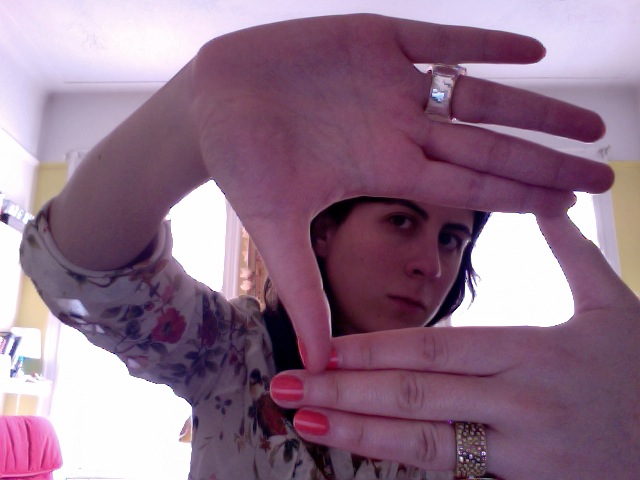
Where and how did I learn the script for my life? In the kind of work I do, scriptwriters have the power of scripting the way characters act in new and unexpected ways; therefore giving us, their audience, the possibility to rescript ours. A powerful script has the ability to reshape our imagination, to change the collective imaginary and even change social norms. There are so many ways to live, there are even more ways to tell the story of life; you can always choose the words you use to do so. As an amateur photographer I understand the importance of framing; selecting a piece of reality. But selection is not in the realm of scarcity, you can take as many pictures as you want, you can select as many frames as you wish. As an editor I know it is also possible to make your frames magical, sometimes. Reminding people about their ability to reframe their lives, to change their lens, is truly empowering. This pose an opportunity to rethink, redesign and add value to what they have decided; to where their decisions have taken them. It provides the chance to leave any guilt behind, to be kind to themselves, and to even start all over again. If they wish.